Carver Regulatory Context Graph
External regulatory context for AI agents — at dev time and at run time.
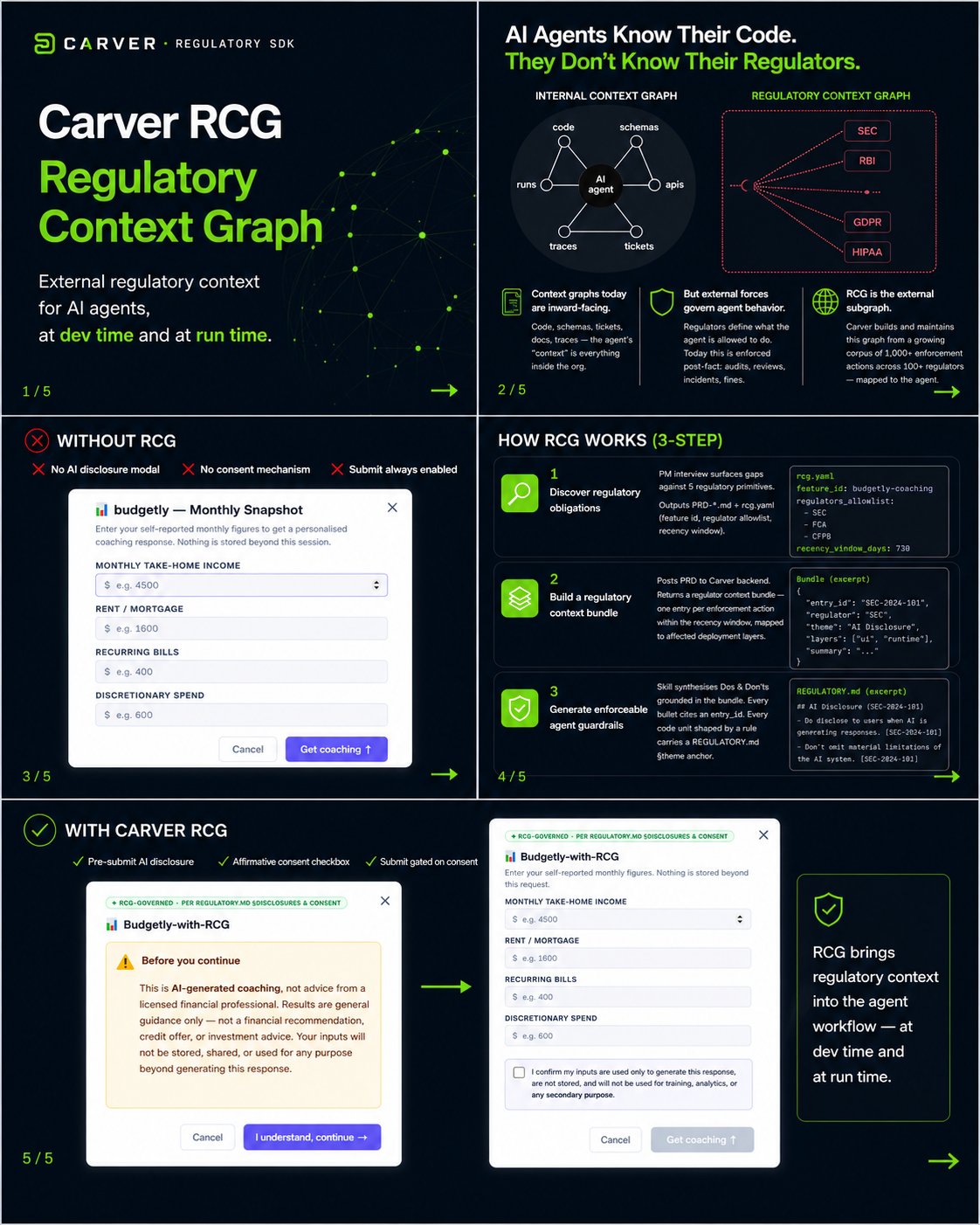
The Problem
AI agents are built with rich internal context: code, schemas, tickets, docs, traces. They know your system well. But they don't know what they're allowed to do.
Regulators — SEC, RBI, MAS, FCA, GDPR, HIPAA, CFPB, and hundreds more — define the legal boundaries that govern every AI action and output. Today, compliance with those boundaries is enforced post-effect: audits, incident reviews, fines. By the time a violation is caught, the product has already shipped it.
RCG moves compliance to before the incident. It gives your AI agents the external regulatory context they need — at the moment they're writing code, and at the moment they're serving a user.
What RCG Is
The Regulatory Context Graph is an ever-growing knowledge graph built from 1,000+ regulators across 100+ geographies, scanned daily by Carver. For a given feature, RCG identifies which regulators apply, fetches the relevant guidance and enforcement signals, and synthesizes it into a single file: RCG.md — a structured set of dos and don'ts your agents can consume directly.
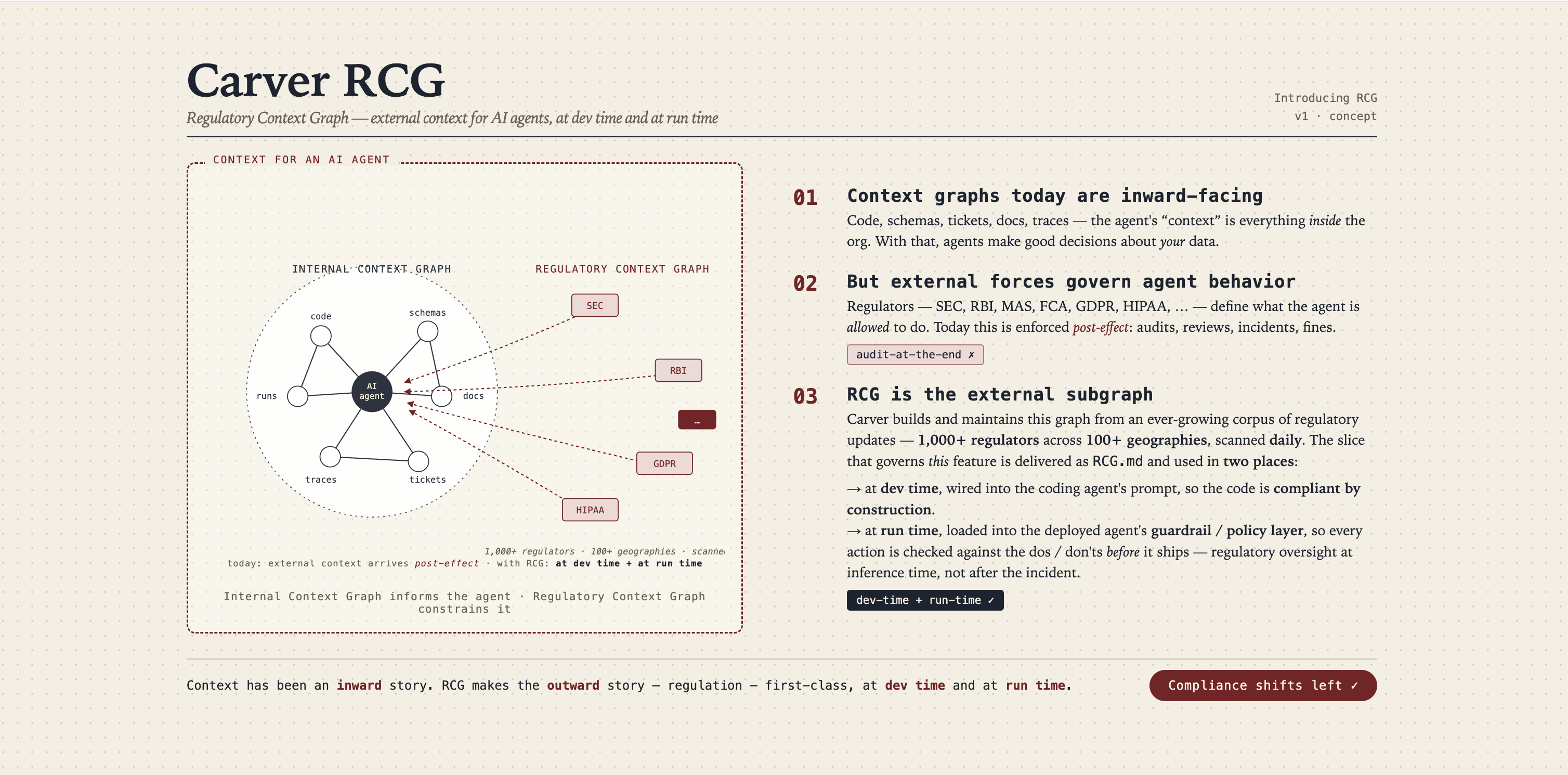
There are three core ideas:
-
Context graphs today are inward-facing. Code, schemas, tickets, docs — the agent's context is everything inside the org. That makes agents good at your data, but blind to external law.
-
External forces govern agent behavior. Regulators define what an agent is allowed to do. Today that's enforced post-effect — audits, reviews, fines. RCG brings it pre-effect.
-
RCG is the external subgraph. It delivers the regulatory slice that governs a specific feature, and plugs it into two places: the coding agent's prompt at dev time, and the deployed agent's guardrail at run time.
Two Modes
| Mode | When | What happens |
|---|---|---|
| Dev time | While building a feature | RCG.md is injected into the coding agent's prompt. Every prompt carries regulatory context — code is compliant by construction. |
| Run time | While serving users | RCG.md is loaded into the deployed agent's guardrail/policy layer. Every action and output is checked against the dos/don'ts before it reaches the user. |
Next Steps
- How It Works — the 3-step process to generate an RCG context bundle
- Dev Time Integration — using RCG in Claude Code and coding agents
- Run Time Guardrails — enforcing compliance in production agents