Run Time Guardrails
At run time, the same RCG.md that guided development is loaded into your deployed agent's guardrail layer — checking every action and output against the regulatory dos and don'ts before it reaches the user.
How It Works
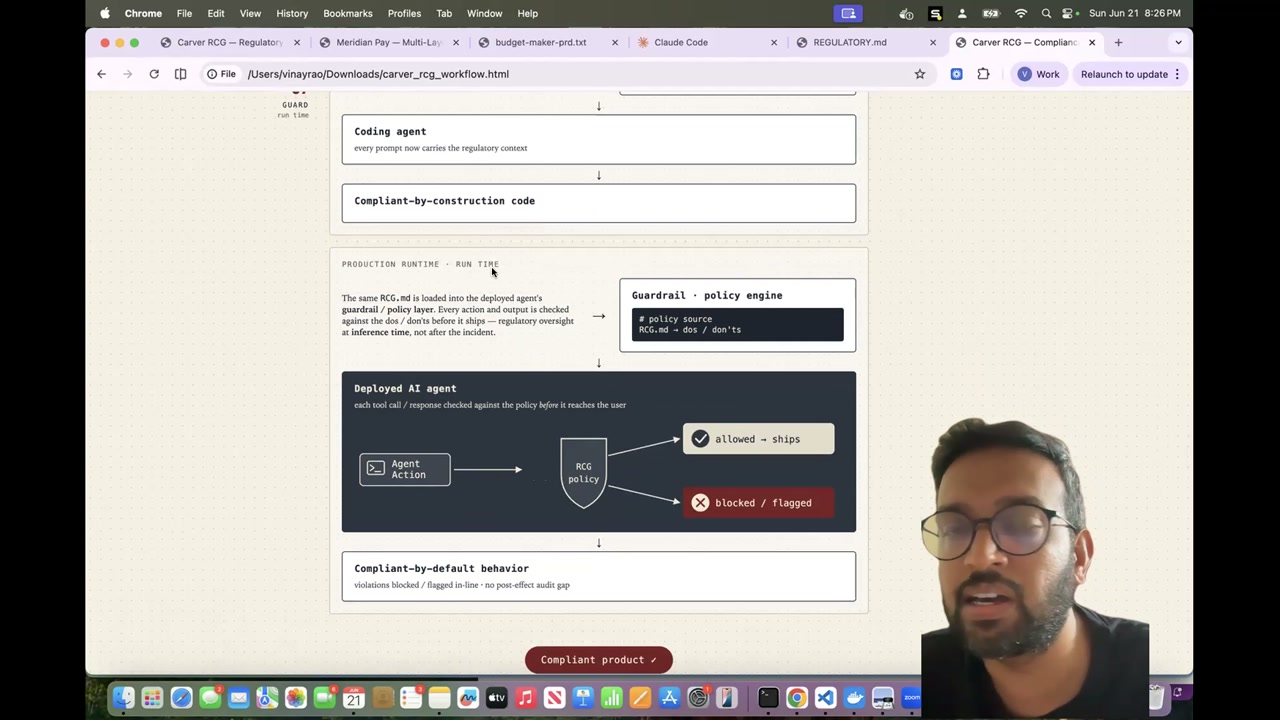
When an AI agent is deployed in production, it operates inside a layered architecture. The RCG.md file is loaded into the guardrail / policy engine as the policy source:
Every agent action and output passes through this policy check at inference time:
- Allowed → ships — the action is within the regulatory boundaries; it proceeds to the user
- Blocked / flagged — the action violates a dos/don't from
RCG.md; it is stopped or flagged before it ships
This means regulatory oversight happens at the moment of inference, not after an audit. There is no post-effect gap.
The 7-Layer Deployment Stack
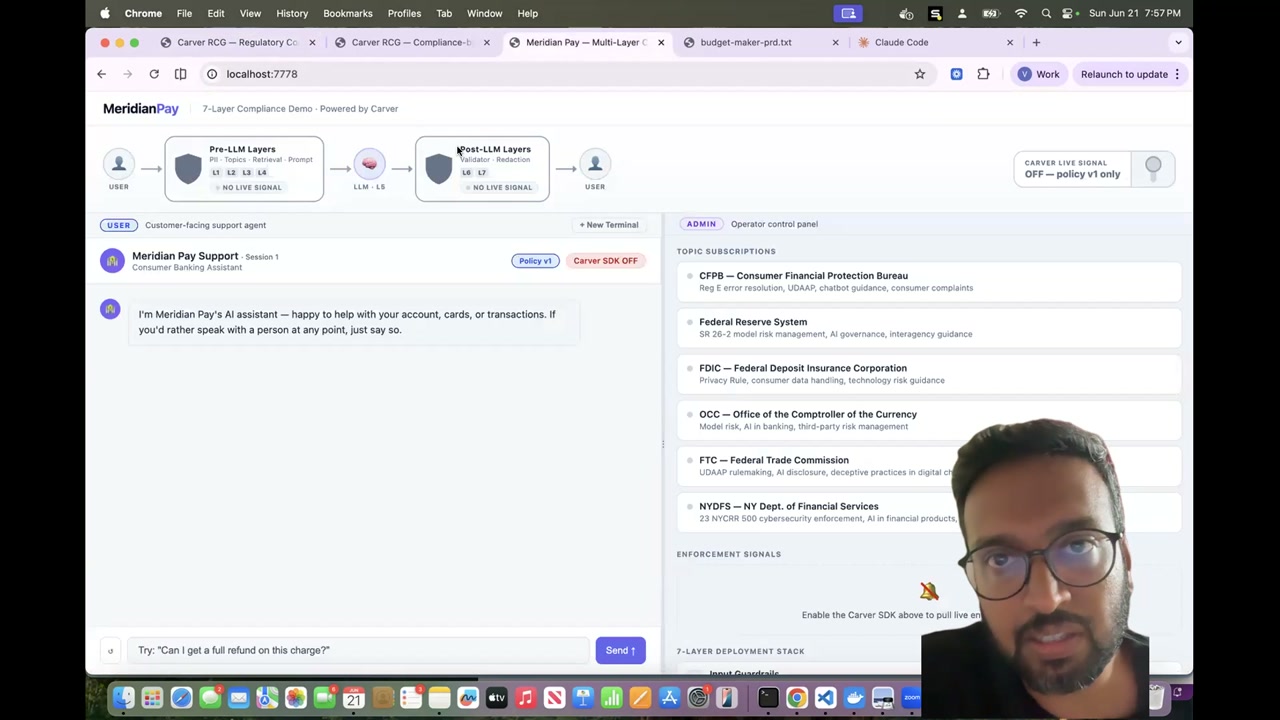
The MeridianPay demo illustrates how RCG slots into a full compliance-by-construction agent architecture:
| Layer | Role |
|---|---|
| Pre-LLM layers (L1–L5) | PII detection, topic routing, retrieval, prompt construction |
| LLM (L5) | The core language model |
| Post-LLM layers (L6–L7) | Validator and redaction — where the RCG guardrail runs |
The right panel of the admin console shows:
- Topic subscriptions — the regulators actively monitored for this agent (CFPB, Federal Reserve, FDIC, OCC, FTC, NYDFS), each with a description of the specific guidance being enforced
- Enforcement signals — live enforcement actions from those regulators, surfaced in real time when the Carver SDK is enabled
Live Enforcement Signals
When the Carver SDK is enabled, the guardrail layer receives live enforcement signals from Carver's regulatory monitoring network. If a regulator issues new guidance or an enforcement action that affects your agent's behavior, the policy engine can be updated without a code deployment.
This closes the gap between when a regulation is issued and when your agent complies with it — from weeks (waiting for the next audit cycle) to hours (next signal fetch).
Compliant-by-Default Behavior
The outcome of run time RCG enforcement is:
- Violations are blocked or flagged in-line — the user never sees non-compliant output
- No post-effect audit gap — compliance is proven at inference time, not reconstructed from logs after an incident
- Consistent enforcement — the same
RCG.mdthat shaped the code also governs the deployed behavior, so there's no drift between what was built and what's enforced